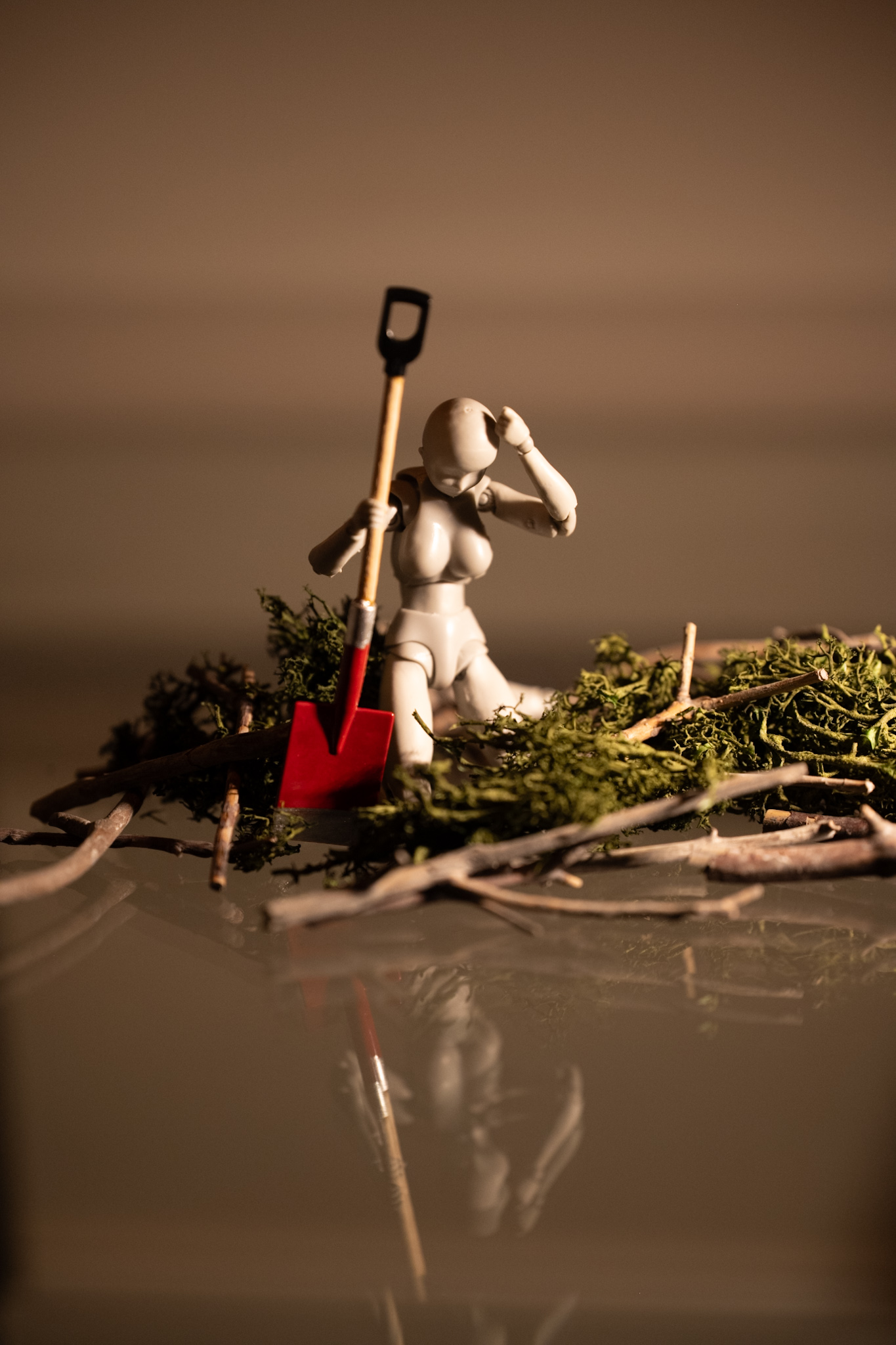
In the midst of today’s National Shutdown, I’m resurrecting this image from my conceptual art portfolio, “Dry Bones (Ezekiel 37),” which began in 2023, as I was examining how God’s love was restoring areas of spiritual decay in the hidden places of my heart, which I call “My Unruly Garden.”
Today’s blog post turns outward, examining the broader “Unruly Garden” of our nation, with a focus on restoration and hope, amid the spiritual decay of fear that threads through current events.
Our nation’s spiritual decay of fear has led some to oppress the very people God calls us to love.
“He shows love to the foreigners living among you and gives them food and clothing. So you, too, must show love to foreigners, for you yourselves were once foreigners in the land of Egypt.”
Deuteronomy 10:18–19 (NLT)
Spiritual decay is produced when we eat the “decoy” fruit that is masking as “good” fruit. In other words, when we choose to eat the fruit of fear and apathy, over faith and love. And the more you eat the decoy fruit, the more spiritually blind you become.
I’m focusing today’s post on the fallout of fear and its effect on those we should be caring for—the foreigners, the poor, and the oppressed.
Fear has become a driving force in our national story—one often muted by the white noise of comfort and complacency. But ignoring it doesn’t silence it. It only makes it louder.
As I’ve watched events unfold in Minneapolis in recent weeks, I was drawn back to the aftermath of Hurricane Katrina. While a different tragedy, the same spiritual decay of fear ran through the response. Vulnerable neighbors were portrayed as violent “criminals,” cast as threats from whom first responders needed protection.
I revisited my journal from August 13, 2025, when I watched Episode 4 of Hurricane Katrina: Race Against Time (2025). It rocked my soul then—and it does again now, as we witness the same thread playing out in Minneapolis (and countless other events).
A reporter described the scene at the New Orleans Convention Center:
“These people haven’t seen security here for four days. The fear was that they would turn violent—that they would attack supplies and buses. And look at them.”
(The camera pans across people who are weary, exhausted, malnourished, yet sitting quietly.)
“They’re sitting peacefully. They’re just waiting for a ride that’s taking too long to come.”
In the next scene, retired U.S. Army Lieutenant General Russel L. Honoré, who commanded the Joint Task Force for Katrina, responds:
“I call that the patience of the poor. I grew up that way. You learn to wait. When you’re poor, you lose choices. You don’t pick where your kids go to school. You don’t pick where you live. And you don’t pick where you go to the doctor—if you can get to see one.”
Foreigners in this country are navigating the same reality. Instead of being treated as image-bearers of God, they are treated like criminals. And the narrative driving this distortion is the same one we’ve seen before: fear.
God does not give us a spirit of fear. He gives us a spirit of love.
Fear is not truth. Fear separates us from truth.
These are foundational biblical realities—yet the enemy is skilled in subtlety. He flips the script just enough to normalize death, while disguising it as protection.
The enemy dupes us into tending graves when God calls us to tend gardens.
God’s way restores the broken and cultivates life.
The enemy’s way breaks the broken and produces death.
So the question remains: When will enough be enough?
These current events feel reminiscent of Ezekiel’s “Valley of Dry Bones.” We hear the rattling and assume fear means resurrection is no longer possible—while God waits for His people to call out to Him and speak life.
God, breathe life into this nation of dry bones!
“Then he said to me, “Son of man, these bones represent the people of Israel. They are saying, ‘We have become old, dry bones—all hope is gone. Our nation is finished.’ Therefore, prophesy to them and say, ‘This is what the Sovereign Lord says: O my people, I will open your graves of exile and cause you to rise again. . . When this happens, O my people, you will know that I am the Lord.
Ezekiel 37:11-13 NLT
What we need is not necessarily louder rhetoric, but a humbler heart posture—one rooted in acts of love, with a servant heart for our vulnerable neighbors—the foreigner, the poor, and the oppressed. And to treat them with dignity and respect, as those created in God’s image.
“And I will give you a new heart, and I will put a new spirit in you. I will take out your stony, stubborn heart and give you a tender, responsive heart.”
Ezekiel 36:26 NLT
As the thorns and thistles of this life (death, injustice, hardship, suffering) arise, as they always do, we have a choice—
Will we tend the grave (fear, apathy) or tend the garden (faith and love)?
One path leads to more destruction and death. The other leads to restoration and life.